Wednesday, March 28, 2012

Peter Puck, The 1970's Ambassador To The NHL


Another much loved segment of Hockey Night In Canada and NBC's Hockey Game Of The Week, for the children anyways, was the Peter Puck cartoon that was generally shown in the intermission between the first and second periods of the game.
 
His first immortal words spoken between periods in 1973 were "
Howdy fans, Peter Puck here to lay some facts on you about hockey - the world's fastest team sport." He often referrered to himself as the "pokecheck professor".
 

The animated little puck would explain the rules of hockey to the junior crowd as well as equipment used in the games to keep your child safe and even ventured into the history of the sport of...you guessed it, hockey! It was adapted to TV with the help of Hanna Barbera a very popular cartoon company of the time.

The animated cartoons were designed to keep the kids happy between the first and second intermission of the hockey game.

1. Peter Puck - How To Play The Game (episode 1)

2. Peter Puck - Equipment, Officials and Players (episode 2)

3. Peter Puck - Pucks, Skates and Sticks (episode 3)

4. Peter Puck - Penalties, Signs and Fines (episode 4)

5. Peter Puck - Episode 5

Three books - Peter Puck: Love That Hockey Game (1975), Peter Puck and the Stolen Stanley Cup (1980), and Peter Puck's Greatest Moments in Hockey (1980) were also written and have all been given collectors item status.


Love That Hockey Game
The Stolen Stanley Cup
                  
Greatest Moments In Hockey


Wednesday, March 14, 2012

1970-71 O-Pee-Chee Hockey Cards

The 1970-71 Topps Hockey Card Series were almost identical for the first 132 cards with the one exception being card #24 which was Bob Baun in the Topps Series and a checklist in the O-Pee-Chee Series. Another difference was the little write up on each player on the back of the O-Pee-Chee card was in English and French.

132 Checklist
133 Ed Johnston
134 Ted Green
135 Rick Smith RC
136 Derek Sanderson
137 Dallas Smith
138 Don Marcotte RC
139 Ed Westfall
140 Floyd Smith
141 Randy Wyrozub RC
142 Cliff Schmautz RC
143 Mike McMahon
144 Jim Watson
145 Roger Crozier
146 Tracy Pratt
147 Cliff Koroll RC
148 Gerry Pinder RC
149 Ron "Chico" Maki
150 Doug Jarrett
151 Keith Magnuson RC
152 Gerry Desjardins
153 Tony Esposito
154 Gary Bergman
155 Tom Webster RC
156 Dale Rolfe
157 Alex Delvecchio
158 Nick Libett
159 Wayne Connelly
160 Mike Byers RC
161 Bill Flett
162 Larry Mickey
163 Noel Price
164 Larry Cahan
165 Jack Norris RC
166 Ted Harris
167 Murray Oliver
168 Jean-Paul Parise
169 Tom Williams
170 Bobby Rousseau
171 Jude Drouin RC
172 Walt McKechnie RC
173 Cesare Maniago
174 Rejean Houle RC
176 Henri Richard
177 Guy Lapointe RC
178 J.C. Tremblay
179 Marc Tardif RC
180 Walt Tkaczuk
181 Jean Ratelle
182 Pete Stemkowski
183 Gilles Villemure
184 Rod Seiling
185 Jim Neilson
186 Dennis Hextall
187 Gerry Ehman
188 Bert Marshall
189 Gary Croteau RC
190 Ted Hampson
191 Earl Ingarfield
192 Dick Mattiussi
193 Earl Heiskala
194 Simon Nolet
195 Bobby Clarke RC
196 Garry Peters
197 Lew Morrison RC
198 Wayne Hillman
199 Doug Favell
200 Les Binkley
201 Dean Prentice
202 Jean Pronovost
203 Wally Boyer
204 Bryan Watson
205 Glen Sather
206 Lowell MacDonald
207 Andy Bathgate
208 Val Fonteyne
209 Jim Lorentz RC
210 Glenn Hall
211 Bob Plager
212 Noel Picard
213 Jim Roberts
214 Frank St. Marseille
215 Ab McDonald
216 Brian Glennie RC
217 Paul Henderson
218 Darryl Sittler RC
219 Dave Keon
220 Jim Harrison RC
221 Ron Ellis
222 Jacques Plante
223 Bob Baun
224 George Gardner RC
225 Dale Tallon RC
226 Rosaire Paiement RC
227 Mike Corrigan RC
228 Ray Cullen
229 Charlie Hodge
230 Len Lunde
231 Terry Sawchuk
232 Stanley Cup Champs [Boston Bruins Team]
233 Ken Hodge [Esposito Line]
234 Tony Esposito [First Team All-Star]
235 Bobby Hull [First Team All-Star]
236 Bobby Orr [First Team All-Star]
237 Phil Esposito [First Team All-Star]
238 Gordie Howe [First Team All-Star]
239 Brad Park RC [First Team All-Star]
240 Stan Mikita [Second Team All-Star]
241 John McKenzie [Second Team All-Star]
242 Frank Mahovlich [Second Team All-Star]
243 Carl Brewer [Second Team All-Star]
244 Ed Giacomin [Second Team All-Star]
245 Jacques Laperriere [Second Team All-Star]
246 Bobby Orr [Hart Trophy]
247 Tony Esposito [Calder Trophy]
249 Bobby Orr [Art Ross Trophy]
250 Tony Esposito [Vezina Trophy]
251 Phil Goyette [Lady Byng Trophy]
252 Bobby Orr-Conn Smythe Trophy Winner [Conn Smythe]
253 Hubert "Pit" Martin [Masterton Award]
254 The Stanley Cup
255 Prince of Wales Trophy
256 Conn Smythe Trophy
257 James Norris Trophy
258 Calder Trophy
259 Vezina Trophy
260 Lady Byng Trophy
261 Hart Trophy
262 Art Ross Trohpy
263 Clarence Campbell Bowl
264 John Ferguson
111A Brit Selby
111B Brit Selby
175A Mickey Redmond
175B Mickey Redmond
248A Bobby Orr [Norris Trophy]
248B Bobby Orr [Norris Trophy]

I'll try to explain the Brit Selby 111A and 111B card.
First of all the cards are the same front and back as far as photo and write up goes. What separates the two is that the A card does note denote the trade Toronto had done with St. Louis where as the B card mentions this on the front of the card with the notation “Traded From Toronto Nov. 13/70”

The Bobby Orr Norris Trophy alternative makes a notation of Gordie Howe on the puzzle piece on the back of the card where as the A card does not.

Friday, March 9, 2012

1971-72 Colgate Toothpaste Hockey Heads

A Colgate toothpaste promotion in the winter months of 1972 had kids buzzing and brushing with the hope they might "score" a Bobby Orr head which were being included in specially marked packages of Colgate toothpaste.


They were manufactured as a tribute to players of Team Canada who had beaten the Russians in an eight game series in September 1972 winning 4, losing 3 and 1 tie.

In all there were 16 busts in the collectible series, each measuring about 1 1/4 " in height with a base of about 7/8" and were made of a cream colored or beige plastic.

Out of the 16 heads there was still room for an error and was found in the spelling of Norm Ullmans name which they spelled Ullmann.


The sixteen players chosen for the promotion were:

1 Bobby Orr

2 Brad Park

3 Ken Dryden

4 Jean Ratelle

5 Paul Henderson

6 Jacques Plante

7 Richard Martin

8 Marcel Dionne

9 Derek Sanderson

10 Frank Mahovlich

11 Walter Tkaczuk

12 Norm Ullman

13 Gary Unger

14 Dale Tallon

15 Norm Ullmann(defect)

16 Guy Lafleur

17 Yvan Cournoyer


Friday, March 2, 2012

1970-71 Topps Hockey Card Checklist

1970-71 Topps Hockey Cards
This set is nearly identical to the first 132 cards of the 1970-71 O-Pee-Chee set - the exception is card #24, a checklist in the O-Pee-Chee set and Bobby Baun in Topps. Some of the photos are also different.

This checklist is meant to give those interested a look at what the cards actually look like. I do not have these cards for sale it is a pictorial reference only.
#Description
1Gerry Cheevers
2Johnny Bucyk
3Bobby Orr
4Don Awrey
5Fred Stanfield
6John McKenzie
7Wayne Cashman RC
8Ken Hodge
9Wayne Carleton
10Garnet "Ace" Bailey RC
11Phil Esposito
12Lou Angotti
13Jim Pappin
14Dennis Hull
15Bobby Hull
16Doug Mohns
17Pat Stapleton
18Hubert "Pit" Martin
19Eric Nesterenko
20Stan Mikita
21Roy Edwards
22Frank Mahovlich
23Ron Harris
24Bob Baun
25Pete Stemkowski
26Garry Unger
27Bruce MacGregor
28Larry Jeffrey
29Gordie Howe
30Billy Dea
31Denis DeJordy
32Matt Ravlich
33Dave Amadio
34Gilles Marotte
35Eddie Shack
36Bob Pulford
37Ross Lonsberry
38Gord Labossiere
39Eddie Joyal
40Lorne "Gump" Worsley
41Bob McCord
42Leo Boivin
43Tom Reid RC
44Charlie Burns
45Bob Barlow
46Bill Goldsworthy
47Danny Grant
48Norm Beaudin RC
49Rogatien Vachon
50Yvan Cournoyer
51Serge Savard
52Jacques Laperriere
53Terry Harper
54Ralph Backstrom
55Jean Beliveau
56Claude Larose
57Jacques Lemaire
58Pete Mahovlich
59Tim Horton
60Bob Nevin
61Dave Balon
62Vic Hadfield
63Rod Gilbert
64Ron Stewart
65Ted Irvine
66Arnie Brown
67Brad Park RC
68Ed Giacomin
69Gary Smith
70Carol Vadnais
71Doug Roberts
72Harry Howell
73Joe Szura
74Mike Laughton
75Gary Jarrett
76Bill Hicke
77Paul Andrea RC
78Bernie Parent
79Joe Watson
80Ed Van Impe
81Larry Hillman
82George Swarbrick
83Bill Sutherland
84Andre Lacroix
85Gary Dornhoefer
86Jean-Guy Gendron
87Al Smith RC
88Bob Woytowich
89Duane Rupp
90Jim Morrison
91Ron Schock
92Ken Schinkel
93Keith McCreary
94Bryan Hextall
95Wayne Hicks RC
96Gary Sabourin
97Ernie Wakely RC
98Bob Wall
99Barclay Plager
100Jean-Guy Talbot
101Gary Veneruzzo
102Tim Ecclestone
103Gordon "Red" Berenson
104Larry Keenan
105Bruce Gamble
106Jim Dorey
107Mike Pelyk RC
108Rick Ley
109Mike Walton
110Norm Ullman
111Brit Selby
112Garry Monahan
113George Armstrong
114Gary Doak
115Darryl Sly RC
116Wayne Maki
117Orland Kurtenbach
118Murray Hall
119Marc Reaume
120Pat Quinn
121Andre Boudrias
122Poul Popiel
123Paul Terbenche
124Howie Menard
125Gerry Meehan RC
126Phil "Skip" Krake
127Phil Goyette
128Reg Fleming
129Don Marshall
130Bill Inglis RC
131Gilbert Perreault RC
132Checklist
14 rookie cards in set.

Thursday, March 1, 2012

1970-71 Esso NHL Power Players


By the winter of 1970 I was eight years old and the hockey card bug had bitten hard.

Not only did O-Pee-Chee and Topps have what I personally consider their finest set of cards ever printed but Esso gas stations in Canada were running a promotion where with a gasoline purchase, a mimimum of $3.00, you were given a booklet of six hockey stamps which they called NHL Power Players.


1970-71 NHL Power Player Stamp Packet


Inside Stamp Packet


These Power Players came with a little blue plastic wallet(shown below) to keep your spares in for trading purposes. There was also a soft cover album that came with some players already printed in the book and a deluxe hard cover edition that required you to collect all the trading stamps to complete. There were 252 cards in the set which came out to 18 players for each of the 14 NHL teams.


Soft Cover Album
Hard Cover Edition


Now, the idea was simple enough. Have Mom or Dad fill up their car at Esso and collect the stamps each time. Problem was what happened if they bought their gas at a competitors gas station?

For me personally I remember getting some Power Player stamp booklets from my Uncle David whos father owned the Esso station in town at that time. But it wasn't until several years later when visiting my cousins in a small northern Ontario community that I finally layed my hands on a complete set of NHL Power Players in a soft cover album.


1970-71 NHL Power Player Stamps

NHL Power Player Trader Wallet
                                
If you are old enough to remember collecting NHL Power Player Stamps you likely also remember the catchy commercials Esso had to promote the cards generally shown during Hockey Night In Canada broadcasts on Saturday Night. Below, you'll find links to some of Imperial Oil Essos timeless commercials, aired during the fall and winter months of 1970-71, that will take some of us back to a era when heroes were real.

1. NHL Power Players Promotion #1

2. NHL Power Players Promotion #2

3. NHL Power Players Promotion #3

4. NHL Power Players Promotion #4

5. NHL Power Players Promotion #5

6. NHL Power Players Promotion #6

The above commercials are provided to the public via Youtube by Glenbow Archives who feature Imperial Oil Esso television commercials from the 1950s to the 1970s.

Wednesday, February 8, 2012

1970-71 O-Pee-Chee/Topps Hockey Cards

Bobby Orr Topps Card
With the dawning of the 1970-71 O-Pee-Chee hockey card series came two new expansion teams to the NHL namely the Buffalo Sabres and the Vancouver Canucks.

The cards that remain most elusive today however are not the players of the expansion teams but those of one of the Original Six teams, the Boston Bruins.

The Bruins, having just won the Stanley Cup prior to the release of the 1970-71 O-Pee-Chee set took the first eleven card slots in the series including Bobby Orrs card #3. The famous defensemans image can also be found on five other cards in the 1970-71 O-Pee-Chee series.

The problem with getting these cards in really good shape comes from the fact that they were near the top of the stack in most collectors piles and therefore suffered other wear and tear cards further down didn't suffer from. A main culprit in a cards poor condition came from using rubber bands to hold the stack together. The cards near the top and bottom of the stack usually ended up with "band marks" on their edges. The other problem came from the factory where the cards were cut with an awful lot of them being cut on an angle making the card O/C or off center which is in reference to how the white boarder looks on the face of the card.

PSA, a card grading and authentication service reported only one Bobby Orr, card number 3, PSA Gem Mint 10 having been uncovered and a PSA Mint 9 sold on Ebay in July 2007 for $1412.50.

Another tough Bruin to find in high grade shape is #5, Fred Stanfield because of its position in the top row of the factory sheets, it's most often found O/C top to bottom.(off center) Of the dozen or so graded by PSA only 2 have been graded a PSA 8 and none have been graded higher. A PSA 8 sold on Ebay in December 2007 for $161.50.

The 1970-71 O-Pee-Chee set was distributed in two 132 card series. The first series cards remain the toughest to collect in high grade status.


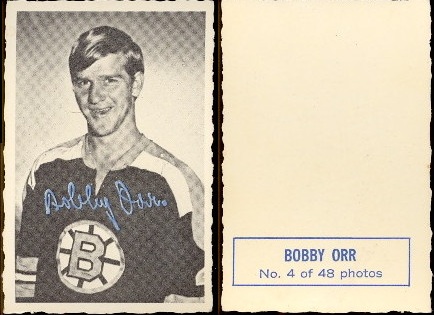
Bobby Orrr Deckle Edge Card

Bobby Orr Sticker Stamp


First series packs contained eight cards and a sticker stamp. The sticker stamp set consisted of 33 unnumbered color stamps with a blank back. The stamps were inserted in the 1970-71 Topps wax packs as well as in the first series of the Canadian O-Pee-Chee wax packs.

Second series packs contained eight cards and a Deckle Edge card that was substituted for the sticker stamp. Deckle Edge cards were black and white photos of players and each photo carried a facsimile autograph. There were 48 Deckle Edge cards in the second series.

The standard format of the 1970-71 set featured the players photo, position played and team name and white borders on the front with a green back that highlighted personal statistics by year, a short biography in French and English, the card number and a cartoon like sketch of the player.

Variations do exist of several cards in the series the most notable being card number 111, Brit Selby. Most show the St. Louis Blues as his team name with a notation "Traded from Toronto November 13, 1970". A version showing Selby as a member of the Toronto Maple Leafs without the trade notation also exists but is very rare.

It is thought that Selby was traded sometime early in the production of the first series and that the print process was halted to update the trade.

A similar card, number 175, Mickey Redmond states he was "Traded to Detroit January 13, 1971" in the upper right hand corner. In Redmonds instance the card without the trade information is the most abundant to collectors.

Card number 248, the Bobby Orr Norris Trophy winner single has an evil twin also. One version states "Gordie Howe NHL All Time Leading Scorer" on the back while it's twin doesen't. A premium price is generally not recognized for either version.

Over and above the six Bobby Orr cards contained in the series the 1970-71 O-Pee-Chee set also boasts cards of NHL legends Bobby Hull, #15, Gordie Howe, #29, Phil Esposito, #11 and Terry Sawchuck, #231. Five future Hall Of Famer rookie cards are also contained in this set including Gilbert Perreault, #131, Guy Lapointe, #177, Brad Park, #67, Darryl Sittler, #218 and Bobby Clarke, #195.

Bobby Clarke Rookie Card

The Bobby Clarke card, #195, has always been regarded as the key rookie card of the set but compared to the Gilbert Perreault card, #131 it is reasonably easy to come by in high grade status. Of the couple hundred Clarke cards submitted to PSA for grading there has been two PSA 10 and nineteen PSA 9. A PSA 9 sold on Ebay for $658 in April 2008. The Perreault card, out of seventy-seven graded by PSA there was only one PSA 10 and two PSA 9's. Centering top to bottom seems to be the biggest problem with this card and again it was in the top row of the first series sheets. The only PSA 10 Gilbert Perreault card sold for $2827.77 on Ebay in June 2008.

Other notable rookie cards in this set include Wayne Cashman, #7, Don Marcotte, #138 and Walt McKechnie, #172. In all there were forty-one rookie cards in this set.

Like the Stanfield card #114, Gary Doak is also hard to find in top condition. Of twenty-three sent to PSA for grading the highest grade was a PSA 8. Centering is the problem with this card also. A PSA 8 sold on Ebay for $201.50 in January 2008.

Also evading PSA's highest honors is #121, Andre Boudrias. Out of ten graded only two have graded as high as PSA 8. A PSA 8 sold on Ebay for $210.21 in March 2008.

Saturday, May 14, 2011

1970's Hockey Card Collecting

Everybody has a starting point in their hockey card collecting career and like one's first kiss it is usually burned into your memory never to be forgotten.

I just happened to hit the hockey card fad in 1970-71, the beginning of a decade, in my opinion, of the most beautiful cards ever marketed by O-Pee-Chee and Topps.

As a ten year old boy in Canada and living in the hometown of one of the NHL's great goaltenders, Roger Crozier, we had all we needed to fuel the imagination of our young, hockey crazy, little minds.

Now collecting hockey cards was not the same back in those days as it has become today. First of all we didn't need to go to the bank for a loan to buy a pack, you could buy them at the local drugstore for a nickel a pack.

The tough part was that all the boys in school bought from the same drugstore so at times there was quite a shortage for new pack cards.

We didn't have hockey card binders with archival plastic pages to store our cardboard treasures in, instead we had "stacks" of maybe a hundred or more cards being held together by rubber bands which in the modern era is a big no-no. It is also one of the most common flaws you'll find in a card from the 70's besides the famous O/C cards. And the most popular method of storing cards when not being played with was, you guessed it, the shoebox. And finally, the hardest thing on a boys cards was, hands down, Mom! Over the years Moms had to have obliterated thousands and thousands of carboard heroes by simply "cleaning your room".

Most of us in those days really didn't collect hockey cards as a means to finish a particular series but rather a means to see who could accumulate the most cards on any given day.

By playing several different games with the cards themselves, usually in the washroom at recess, such as "knock-down", "closest to the wall" or "cover up", one could easily double or triple the amount of cards he showed up with originally. The one with the biggest stack at the end of the day was considered the winner.
Of course you would have to constantly be on the look-out for the recess teacher because if you were caught playing cards you faced loosing your treasures, never to be seen again. I sometimes wonder how many teachers actually subsidized their retirements from confiscated hockey cards!

Now, there was the odd one who chose to collect the superstars of the era such as Bobby Hull, Gordie Howe or Bobby Orr and would sometimes trade 20-30 cards for a player of superstar status. But I'm sure those kids were few and far between.

As I recall collecting was not very difficult in the 70's as there was only one brand of cards, which in Canada was O-Pee-Chee and Topps in the US. Of course other industries tried their hand at distributing cards in Canada during the 1970's with some of them being Esso gas stations, which distributed their very popular NHL Power Player cards with a fill up at their stations in Canada during the winter months of 1970-71, supermarket chains such as Loblaws issued a 324 player set of sticker stamps in 1973-74 and even Colgate toothpaste used NHL related materials to promote their goods. This being a lesson learned from the 1960's when Shirriff Foods added a round plastic coin shaped picture of NHL players to their jello and pudding mixes on store shelves.

The insert cards or promo items that were included in the card packs in those days were not at all considered collectible. They were usually discarded or used for whatever purpose they were designed for. I remember one insert in particular that was a ring with a team logo on it that could be punched out of the cardboard and worn on the finger. I don't remember many being worn at the time and very few were considered trading material. However, the few that did manage to survive are worth a premium in todays collectible market.


<!-- Start of StatCounter Code for Blogger / Blogspot -->
<script type="text/javascript">
var sc_project=7749890;
var sc_invisible=1;
var sc_security="8bd57d2a";
</script>
<script type="text/javascript" src="http://www.statcounter.com/counter/counter_xhtml.js%22%3E%3C/script>
<noscript><div class="statcounter"><a title="blogger counter" href="http://statcounter.com/blogger/" class="statcounter"><img class="statcounter" src="http://c.statcounter.com/7749890/0/8bd57d2a/1/" alt="blogger counter" /></a></div></noscript>
<!-- End of StatCounter Code for Blogger / Blogspot -->